Brooklyn, Connecticut, offers the kind of rural setting many homebuyers want when they are looking for space, privacy, and a quieter pace of life. For buyers hoping to build a custom home, however, finding the right parcel is only the beginning.
Before purchasing land, it is important to understand how zoning, setbacks, lot dimensions, septic requirements, wetlands, and other regulations could affect what you can actually build.
Understanding Brooklyn, CT residential zoning can help you evaluate a property before committing to the purchase. The goal is not simply to find land that looks large enough for a house, but to determine whether the lot can legally and practically support the home you have in mind.
Understanding Brooklyn, CT Residential Zoning Basics
Understanding Brooklyn, CT residential zoning requires identifying your specific district, such as the Residential-Agricultural (RA) zone. Buyers evaluating residential lot zoning in Brooklyn, CT, must adhere to strict minimum acreage requirements, front- and side-yard setbacks, and environmental regulations to ensure their planned home is legally compliant.

Navigating Local Brooklyn Zoning Regulations
In Brooklyn, CT, residential zoning requirements depend on the property's zoning district. Buyers should verify minimum lot area, frontage, setbacks, permitted uses, and applicable environmental requirements before purchasing land.
In the RA Residential-Agricultural Zone, the current minimum lot area is 2 acres, and the minimum frontage is 150 feet. Understanding Brooklyn, CT residential zoning starts with identifying the property's zoning district.
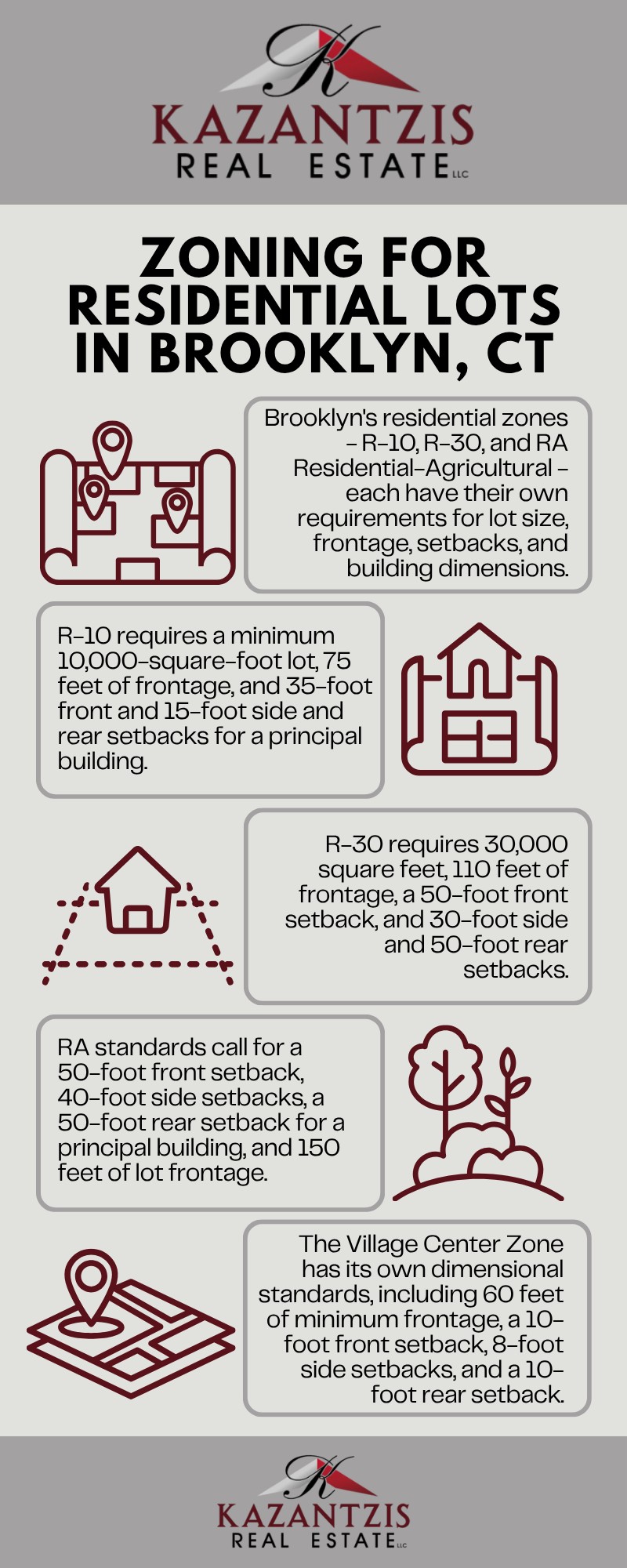
Brooklyn's current zoning regulations establish several residential zones, including R-10, R-30, and RA Residential-Agricultural. Each has its own requirements for lot size, frontage, setbacks, and building dimensions.
For buyers researching residential lot zoning in Brooklyn, CT, the RA zone is particularly important because it is common in the town's more rural areas.
Under the current regulations, an RA lot must generally contain at least 87,120 square feet, or 2 acres, and have at least 150 feet of frontage. Those requirements can significantly affect whether a vacant parcel is suitable for your plans.
The Importance of the Zoning Map
Before choosing a house plan, check the property's zoning designation.
Brooklyn's zoning map is part of the town's zoning regulations, and the Planning and Zoning Commission determines the location of zoning boundaries. If there is uncertainty about a property's zoning classification or boundary, the commission has the authority to determine it.
This is one reason buyers should not rely solely on a real estate listing description. A listing may describe a parcel as residential land, but that does not tell you everything about what can be constructed there.
The official Brooklyn zoning regulations also state that a use or activity that is not clearly permitted within a zone may be prohibited. Buildings and land must conform to the applicable zoning requirements.
Setbacks and Frontage
Setbacks determine how far a building must be located from property lines and the street. They can have a major effect on a home's placement, especially on narrow or irregularly shaped lots.
For example, the current RA standards call for a 50-foot front setback, 40-foot side setbacks, and a 50-foot rear setback for a principal building. The RA zone also requires 150 feet of lot frontage.
Other residential districts have different standards. R-10 requires a minimum 10,000-square-foot lot, 75 feet of frontage, and 35-foot front and 15-foot side and rear setbacks for a principal building. R-30 requires 30,000 square feet, 110 feet of frontage, a 50-foot front setback, and 30-foot side and 50-foot rear setbacks.
The practical takeaway is simple: a lot's acreage alone does not determine whether a particular house will fit.

Finding the Right Residential Lot Zoning in Brooklyn, CT
Residential Agricultural Zones
For buyers seeking a rural property, the RA Residential-Agricultural Zone deserves close attention. Its 2-acre minimum lot area and 150-foot frontage requirement reflect the lower-density character of this district.
That larger lot requirement can also be important when a property relies on private infrastructure. The amount of usable land matters because the house, driveway, well, septic system, reserve areas, and other improvements all need to work together.
A parcel that appears spacious when viewed from the road may have considerably less usable building area once setbacks, wetlands, slopes, drainage, and septic requirements are considered.
Multi-Family and Accessory Dwellings
If you are considering a duplex, in-law apartment, or another additional living arrangement, review the regulations before assuming it will be permitted.
Brooklyn's current regulations specifically address accessory apartments. An accessory apartment in an existing detached garage or customary accessory building requires a Special Permit from the Planning and Zoning Commission.
Only one accessory apartment is permitted on a property, and it cannot exceed the square footage of the primary dwelling. Apartments located within the principal residence are treated differently under the regulations and are considered a duplex.
That distinction can make a meaningful difference when evaluating a property for extended-family living or future rental potential.

Evaluating Brooklyn, CT Land for Sale
Due Diligence on Private Utilities
When evaluating Brooklyn, CT land for sale, do not stop at the asking price, acreage, and road frontage. Determine how the property will receive water and handle wastewater. For land that will rely on an onsite septic system, soil conditions are critical.
Connecticut's Department of Public Health explains that site investigations can involve percolation testing and deep observation pits to evaluate soil, groundwater, and ledge conditions and determine whether a site can support a subsurface sewage disposal system.
A perc test is designed to evaluate how quickly water moves through the soil, while deep test holes help identify soil characteristics, groundwater conditions, and ledge rock. These findings can affect the design and location of the septic system.
For a land purchase, it is wise to make the ability to obtain appropriate septic approval part of your due diligence rather than assuming the lot is buildable simply because it meets the minimum acreage requirement.
Wetlands and Environmental Protections
Wetlands and watercourses can also reduce the portion of a property that is practically available for development. Brooklyn has an Inland Wetlands and Watercourses Commission responsible for matters involving regulated wetland and watercourse activities.
This makes an early wetlands review worthwhile when evaluating vacant land. A survey or wetlands delineation can help identify constraints before you finalize a house location or make significant commitments to a purchase.
Planning Your Brooklyn, CT Real Estate Development
Working With Local Experts
Successful Brooklyn CT real estate development starts well before construction.
Depending on the property and proposed project, buyers may need assistance from a Connecticut-licensed land surveyor, soil professional, engineer, septic designer, builder, and other specialists.
A survey can establish property boundaries, frontage, existing structures, and relevant site features. Soil and septic professionals can evaluate whether the property can support onsite wastewater disposal. A builder can then help determine whether the desired home can be constructed within the site's physical constraints.
For more complicated projects, a pre-application discussion with the appropriate town officials can also help identify potential issues before a formal application is submitted. Brooklyn's zoning regulations specifically provide for pre-application reviews as part of the land-use process.
Securing Your Permits
Do not assume you can begin clearing, excavating, or building simply because you own the property.
Brooklyn's regulations state that construction, alteration, excavation for a building or structure, and changes in land use require the applicable approvals. The regulations also require zoning approval and a building permit, where required, before construction proceeds.
Depending on the project, additional approvals may be necessary for wetlands, septic systems, driveways, stormwater management, or other site improvements.
Brooklyn CT Zoning Requirements Comparison Table
The following table provides a useful starting point for comparing zoning districts. These are general dimensional standards from Brooklyn's current zoning regulations; requirements for a particular parcel should always be confirmed with the Town of Brooklyn before purchasing or developing land.
| Zoning District | Primary Purpose | Typical Minimum Lot Size | Utility Infrastructure |
|---|---|---|---|
| Residential-Agricultural (RA) | Low-density rural living | 2 acres | Often associated with private well and septic systems |
| R-30 Residential | Residential development on larger suburban lots | 30,000 sq. ft. | Depends on location and available infrastructure |
| R-10 Residential | Higher-density residential development | 10,000 sq. ft. | Depends on location and available infrastructure |
| Village Center (VC) | Village-scale development and historic character | 30,000 sq. ft., or an existing smaller lot of record | Public or private infrastructure, depending on location |
The Village Center Zone has its own dimensional standards, including 60 feet of minimum frontage, a 10-foot front setback, 8-foot side setbacks, and a 10-foot rear setback.
It is also important to note that Planned Residential (PRD) should not be treated as a current standard residential zoning district simply because it appears in some older planning materials.
The current Brooklyn regulations identify a Planned Development Zone among the town's special zones, so buyers should verify the actual zoning designation shown on the current zoning map rather than relying on an older district label.
Build Your Future in Windham County
Buying vacant land can be an exciting way to create a home that fits your lifestyle, but the land itself is only part of the equation.
Before purchasing a parcel, confirm its zoning district, minimum lot requirements, frontage, setbacks, permitted uses, and any applicable overlay regulations. Then investigate the physical characteristics of the property, including wetlands, soil conditions, ledge, slopes, access, and septic feasibility.
For buyers researching Brooklyn, CT residential zoning, understanding these requirements early can prevent an expensive surprise later. The current RA minimum of 2 acres, for example, does not automatically mean every 2-acre parcel can accommodate the house you want.
Whether you are comparing residential lot zoning in Brooklyn, CT, looking through Brooklyn, CT land for sale, or considering a larger Brooklyn, CT real estate development project, professional due diligence is one of the smartest investments you can make.
If you are considering buying a residential lot or building a home in Brooklyn, CT, having someone familiar with the local market can make the process much easier. For help evaluating properties, understanding the local market, or finding land that fits your plans, contact our team today at (860) 774-2733 or kazantzisa.re@gmail.com.
Frequently Asked Questions
Where can I find the official map for Brooklyn, CT, residential zoning?
What is the minimum lot size required under Brooklyn zoning regulations?
Do I need a perc test before buying Brooklyn, CT land for sale?
Are accessory dwelling units permitted under residential lot zoning in Brooklyn, CT?
How do wetlands affect Brooklyn, CT, real estate development on vacant land?
What are the standard front yard setbacks in Brooklyn, CT zoning regulations?
Do I need a zoning permit to install a fence on a residential lot in Brooklyn?