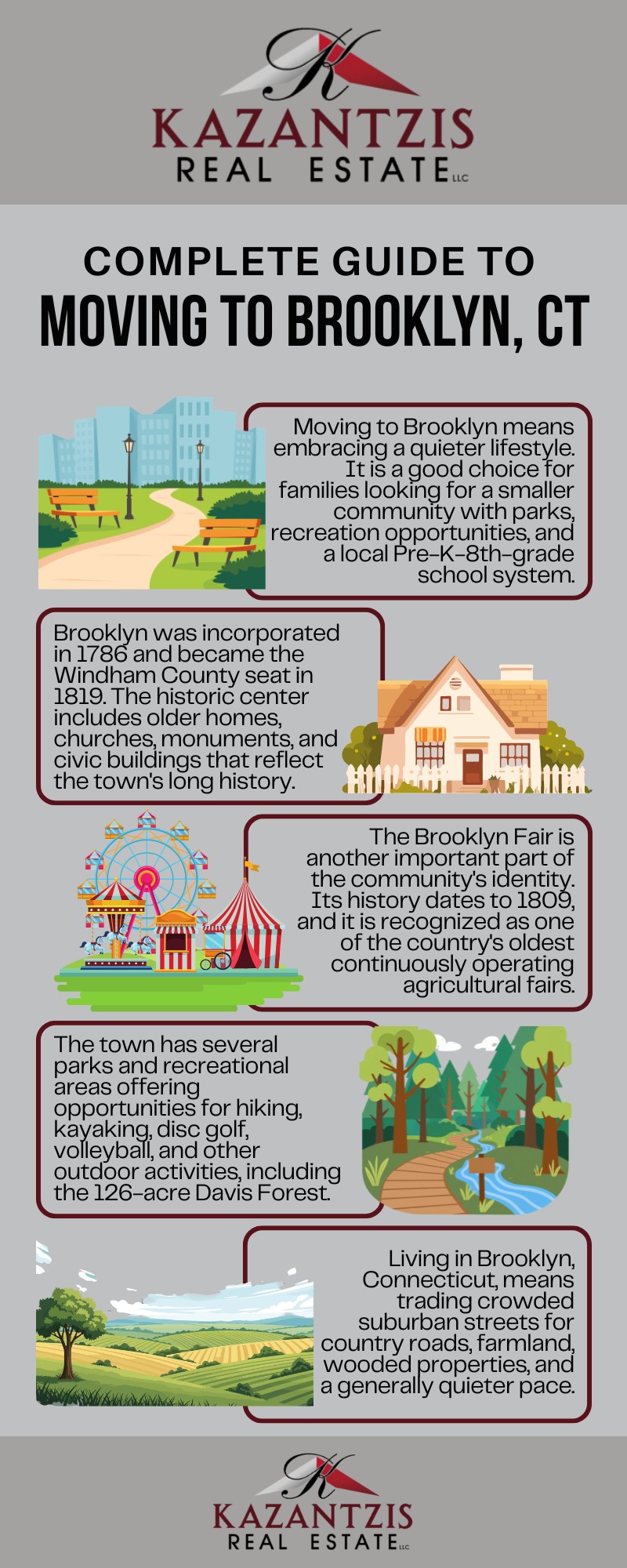
Moving to Brooklyn, CT, offers homebuyers a chance to enjoy a quieter lifestyle in northeastern Connecticut's Quiet Corner.
The town combines rural landscapes, working farms, historic properties, and convenient access to regional highways. Brooklyn covers about 29 square miles and has approximately 8,700 residents.
Its relatively small population and rural character make it an appealing option for buyers seeking more space without being completely removed from regional employment and services.
What to Know When Moving to Brooklyn, CT
Moving to Brooklyn, CT, means embracing a quieter, car-dependent lifestyle surrounded by farms, open space, and historic character. Buyers should research neighborhoods, schools, commuting routes, and well and septic systems. With Route 6 and Route 169 providing regional access, location remains important when choosing a home.
The Unique Charm of Living in Brooklyn, Connecticut
A Slower Pace of Life
Living in Brooklyn, Connecticut, means trading crowded suburban streets for country roads, farmland, wooded properties, and a generally quieter pace.

The town has several parks and recreational areas offering opportunities for hiking, kayaking, disc golf, volleyball, and other outdoor activities. Brooklyn also has the 126-acre Davis Forest, which includes walking trails and areas along the Quinebaug River.
Natchaug State Forest provides another nearby outdoor recreation option. The forest covers more than 13,000 acres across several northeastern Connecticut communities and offers opportunities for hiking, fishing, horseback riding, hunting, camping, and other outdoor activities.
Agriculture remains an important part of Brooklyn's identity. Working farms and agricultural businesses contribute to the area's rural character and help distinguish the town from more densely developed Connecticut communities.
Community and History
Brooklyn was incorporated in 1786 and became the Windham County seat in 1819. The historic center includes older homes, churches, monuments, and civic buildings that reflect the town's long history.

The Brooklyn Fair is another important part of the community's identity. Its history dates to 1809, and it is recognized as one of the country's oldest continuously operating agricultural fairs.
The annual event continues to celebrate the area's agricultural heritage with livestock exhibits, competitions, entertainment, food, and family activities.
For homebuyers, that history is visible in the town's architecture, roads, agricultural landscape, and community traditions.
Navigating the Brooklyn CT Real Estate Market
Property Diversity and Value
The Brooklyn CT real estate market includes a variety of housing types, including ranch-style homes, colonial houses, newer residences, historic properties, and homes on larger parcels. Some properties also include barns, outbuildings, wooded acreage, or land suitable for agricultural uses.
Home prices vary significantly based on property condition, size, acreage, location, and improvements. Buyers should therefore avoid relying on a single townwide figure when determining what they can expect to pay.
Recent market data illustrates this variation. In May 2026, the median sale price in Brooklyn was approximately $369,000. Zillow reported a typical home value of approximately $420,000 in June 2026.
These numbers measure different things: a median sale price reflects completed transactions, while a typical home value is an estimated property value.
For that reason, buyers should use current comparable sales and active listings when determining the appropriate budget for a specific property.
Rural Infrastructure
Rural and semi-rural properties can require more due diligence than homes connected to municipal utilities.
Depending on the property, buyers may encounter private wells and septic systems rather than public water and sewer. A professional inspection should evaluate the home's major systems, while buyers should also review available records concerning the well and septic system.
Buyers considering properties with substantial acreage should also investigate zoning, wetlands, agricultural uses, easements, and potential development restrictions before assuming that additional construction or subdivision will be permitted.
How to Find the Best Brooklyn, CT Homes for Sale
Targeting the Right Neighborhood
When searching for Brooklyn, CT, homes for sale, buyers should pay attention to how the property's location affects convenience and privacy.
The Route 6 corridor is an important commercial and transportation area. The eastern portion of Brooklyn has more intensive commercial development, while central and western areas retain a more residential and rural character.
Homes closer to Route 6 and other developed areas can offer easier access to shopping, restaurants, services, and major roads. Properties farther from commercial areas may provide more privacy, wooded surroundings, farmland, or larger parcels but can require longer drives for everyday needs.
Route 169 is another important consideration. The road passes through Brooklyn's historic center and is designated as a National Scenic Byway, making it particularly relevant for buyers interested in historic character and scenic surroundings.
Working with Local Experts
A real estate agent familiar with Windham County can help buyers identify differences that may not be obvious from an online listing.
Local knowledge can be particularly valuable when evaluating zoning regulations, agricultural uses, wetlands, property boundaries, well and septic systems, and potential land-use restrictions.
Remote workers should also verify internet availability for the specific property rather than assuming that service is identical throughout town. Rural roads and properties can have different service options, so confirming availability before purchasing is worthwhile.
Essential Tips from Our Brooklyn, CT Relocation Guide
Commuter Connectivity
While Brooklyn has a rural character, it is positioned within reach of several regional employment centers.
Route 6 provides an east-west connection through town, while Interstate 395 is located just east of Brooklyn in neighboring Killingly. Route 169 and Route 205 provide additional connections to surrounding communities.
Brooklyn's location puts it within regional driving distance of Norwich, Providence, Worcester, Hartford, and other employment centers. Actual travel times vary depending on traffic, weather, and the specific starting point and destination.
If you commute regularly, test your specific route during your normal travel hours before buying. A property that looks conveniently located on a map may have a very different practical commute during peak periods or winter weather.
Winter Weather Preparation
Buyers moving to Brooklyn from warmer climates should also plan for New England winters.
Depending on the property, homeowners may need to budget for snow removal, winter tires, heating fuel, chimney maintenance, and cold-weather vehicle maintenance. Homes using heating oil or propane also require homeowners to monitor fuel levels and arrange deliveries.
Long or steep driveways deserve particular attention. Snow removal costs and accessibility can become more important during major storms, especially for rural properties.
Brooklyn CT Relocation Comparison Table
| Relocation Feature | Brooklyn CT Lifestyle | Standard Urban Suburb |
|---|---|---|
| Primary Vibe | Quiet, Agricultural, Historic | Fast-paced, Dense, Commercial |
| Real Estate Focus | Brooklyn, CT, real estate | High-Density Subdivisions |
| Average Lot Size | Generally more spacious, with some properties offering substantial acreage | Often smaller residential lots |
| Daily Commute | Car-Dependent / Highway Access | Public Transit / Stop-and-Go |
| Community Events | Agricultural Fairs, Local Markets | City Festivals, Concert Venues |
Brooklyn's rural character is balanced by a commercial corridor along Route 6 and established residential areas around the historic center. The town's agricultural heritage, open space, and historic roads remain important parts of its identity.
Embrace the Quiet Corner Transition
Moving to Brooklyn, CT, can be a strong fit for buyers who value privacy, open space, historic character, and a smaller community over urban convenience.
The key is understanding what comes with that lifestyle. Buyers should be prepared for car-dependent living, investigate well and septic systems where applicable, evaluate winter maintenance needs, confirm internet availability, and research zoning before purchasing a property with significant acreage.
A thoughtful Brooklyn CT relocation guide should also cover schools, commuting, property taxes, utilities, neighborhood characteristics, and current housing conditions.
Whether you're looking for a historic home near the center of town, a ranch on a larger parcel, or a property with room for outdoor activities, researching the specific location and property carefully can help make moving to Brooklyn, CT, a smoother experience.
If you're considering moving to Brooklyn, CT, local guidance can make the home search much easier.
For help comparing neighborhoods, evaluating Brooklyn, CT homes for sale, understanding rural properties, or finding a home that fits your budget and lifestyle, contact us at (860) 774-2733 or kazantzisa.re@gmail.com. We can help you explore your options in Brooklyn and throughout Windham County.
Frequently Asked Questions
Is moving to Brooklyn, CT, a good idea for families?
What is the average price for Brooklyn, CT homes for sale?
How are the public schools for those living in Brooklyn, Connecticut?
What should a comprehensive Brooklyn CT relocation guide include?
Is real estate in Brooklyn, CT, mostly rural or suburban?
How long is the commute from Brooklyn, CT, to major cities?
Are there historic homes available in Brooklyn, CT?